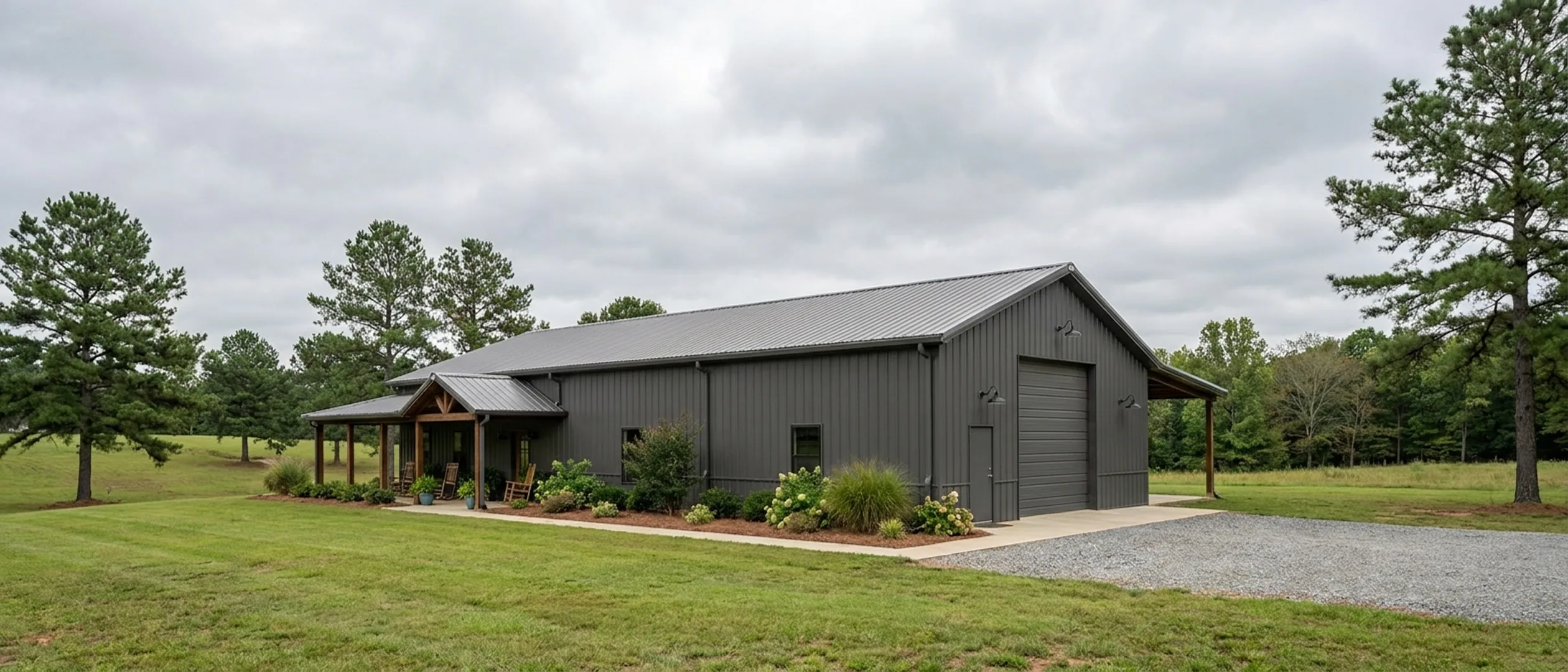
How to Finance a Barndominium in Georgia
Most people are told barndominiums are hard to finance and never told why. The why matters, because it points at something you can prepare for: the valuation file, the paperwork your county does or does not generate, and the program rules that decide the down payment. All three are things you can put in order yourself.
Figures below are industry data from cited third-party sources, not a quote from Georgia Barndominium Builders. Every project is priced individually.
Bottom line up front
- The building type is not the wall. Freddie Mac's Seller/Servicer Guide names barndominiums and shouses outright as eligible non-traditional property types; what stalls the loan is the appraisal.
- Appraisers need comparable sales showing the type is marketable, and those are thinnest in exactly the rural counties where the land is cheapest. Georgia's statewide PT-61 index records every transfer with its sale price, so the comparables can be assembled before the appraisal is ordered rather than argued about afterwards.
- Which of four programs fits is decided by the parcel and the household, not by the county name: USDA's eligibility map follows the urbanized area rather than the county line, and USDA rules owner-builders out of its single-close construction product entirely.
The appraisal is the obstacle, not the building type
This is the most useful thing to understand before you speak to a lender, because it changes who you approach and what you bring.
Freddie Mac names this building type by name
Section 5605.5 of the Freddie Mac Single-Family Seller/Servicer Guide states that mortgages secured by non-traditional types of properties are eligible for delivery, and its list of examples opens with barndominiums, described as barn conversions or barn-style buildings, and shouses, described as living-space and work or storage combinations. Fannie Mae reaches the same place by a different route, covering unique or nontraditional housing types generally rather than naming barndominiums. So the secondary market is not the blocker people expect. What follows in the same Freddie Mac section is.
What the appraiser actually has to produce
Freddie Mac requires the appraisal report to include comparable sales that demonstrate the subject property's dwelling type or style is marketable. It expressly allows traditional homes as comparables for a non-traditional property, provided the appraiser identifies the differences, adjusts for them, and can justify and support the choice. Fannie Mae says it is not necessary for comparables to be of the same design and appeal, but that the appraiser and the underwriter must each independently decide there is enough information for a reliable opinion of value. USDA requires not fewer than three comparable sales unless the appraiser documents that they are not available.
Why thin comparables hit hardest where the land is cheapest
Comparable sales are a function of how many properties change hands nearby. Rural counties have the fewest transactions of any kind, so the appraiser widens the search radius and looks back further than usual. Dense suburban counties have plenty of transactions, but the stock is subdivision houses, so sales of this dwelling type are scarce and the marketability test bites instead. Both problems are real and they sit in different places, which is why the answer is preparation rather than a different county.
Assemble the comparables before the appraisal is ordered
Because Georgia files every transfer through the GSCCCA PT-61 index with the sale price attached, a recent-sales package for your area is something you can actually build. Hand it to the loan officer up front. Doing it before the appraisal is ordered is the difference between an appraiser starting from nothing and one starting from a defensible set of sales, and it costs a subscription and an afternoon.
You get one reconsideration of value, so use it properly
Fannie Mae's Selling Guide section B4-1.3-12 requires lenders to run a borrower-initiated reconsideration of value process, requires the process to be disclosed to you when you receive the appraisal, and states plainly that only one borrower-initiated reconsideration is permitted per appraisal. Your request may include additional data, information or comparable properties, not to exceed five. That is the whole appeal, and it is why the work is better done before the number comes back than after.
Construction-to-permanent, and how the draws follow the build
A ground-up build is not a purchase mortgage. It is a construction loan that becomes a mortgage, and the structure you choose decides when a valuation problem finds you.
The product, in the words of the agencies that publish it
FHA describes construction to permanent as the construction of a dwelling on land owned or being purchased by the borrower, combining a construction loan with a long-term mortgage using a single closing before construction starts. VA's handbook says the same thing: the loan closes before construction begins, proceeds cover the land, the balance goes into escrow, and the escrow pays the builder as work progresses. USDA's combination construction permanent loan works identically and is treated by the Agency as a purchase transaction. One closing instead of two, one set of closing costs.
Every draw needs your signature first
FHA requires the lender to obtain the borrower's written authorization for each draw before funds go to the contractor. VA requires written approval from the borrower before each draw payment to the builder. USDA requires the same, and adds that the lender must keep a draw and disbursement ledger and that total disbursements should not exceed the value of realized material cost and the percentage of work in place. The shell going up in a week does not release the money for it; the money follows work that is actually in place.
The inspection points are the natural breaks in this build
USDA's construction inspection sequence is footings and foundation ready to pour and before back-filling, shell complete with plumbing, electrical and mechanical still exposed, and a final inspection before occupancy. FHA's is footing, framing and final. VA's is foundation, framing and final. Those map cleanly onto how a metal-frame or post-frame house actually goes up, which is why a draw schedule for this building type is not the unusual part of the file.
Overruns and change orders land on you
USDA states it directly: lenders approve change orders during construction, and the borrower is responsible for any cost overruns related to them. USDA permits a contingency reserve but caps it at 2 percent of the cost of construction including labour, materials and soft costs, and it has to sit in the construction escrow. Both FHA and USDA require that money left in the escrow at completion be applied to the principal balance rather than paid out to you.
Single closing or two, and where the valuation risk lands
This is the part worth thinking about hardest. Under Fannie Mae's single-closing rules the loan-to-value on a purchase-type transaction is measured against the lesser of the total cost, meaning construction plus the lot, or the as-completed appraised value from the plans. So a shortfall surfaces before you commit. Under the two-closing rules the permanent mortgage is a separate refinance closing, underwritten on the terms of the permanent loan, which means you are qualified and valued again after the money has been spent. Fannie Mae also caps a single-closing construction period at no single period over 12 months and 18 months in total.
Land: buying it with the build, or already owning it
On a construction-to-permanent loan the land is inside the loan amount, so how and when you acquired it changes the arithmetic more than most people expect.
Land equity counts as your down payment
HUD's handbook states that the borrower may use any cash investment in the acquisition cost of the property, or land equity, to satisfy FHA's minimum required investment. If you already own the acreage, that equity is doing the work a cash down payment would otherwise do. The borrower must either be purchasing the land at the closing of the construction loan or already own it, so there is no route where the land is bought later.
Six months of ownership changes which land number is used
FHA's documented acquisition cost includes the lesser of the cost of the land or its appraised value where the land has been owned six months or less at case number assignment, and the appraised value where it has been owned longer than six months or was received as an acceptable gift. On long-held or inherited Georgia acreage that distinction is worth real money, and it is a reason not to rush from closing on land straight into closing on a build.
Owning the lot first changes what the loan is sized against
Fannie Mae treats a single-closing construction-to-permanent transaction as a purchase if you do not own the lot when advances begin, and as a limited cash-out refinance if you held title before the first advance. The difference is not cosmetic. On the purchase side the loan-to-value is measured against the lesser of cost or as-completed value; on the refinance side it is measured against the as-completed value alone, and the cost ceiling drops out of the calculation.
What the county does to the split
At the Land.com medians for 31 August 2026, an acre in Forsyth County was close to four times an acre in Newton County. On a loan that has to swallow both the land and the building, that is the difference between land being a line item and land being the largest single item in the file. It also decides whether land equity alone can cover a down payment. The uncomfortable pairing is that the counties where the land is cheapest are the counties with the fewest transactions, which is where comparable sales are thinnest.
Owner-builder, and the exemption that stops at the lender's desk
Georgia lets a homeowner build their own house without a contractor licence. That is a state licensing rule, and it does not carry over into the loan file.
FHA will let you be your own contractor only if you are licensed
HUD's handbook is unambiguous: the borrower must have contracted with a builder to construct the dwelling, the builder must be a licensed general contractor, and the borrower may act as the general contractor only if the borrower is also a licensed general contractor. Georgia's owner-builder exemption exists precisely so that a homeowner does not need that licence. The exemption gets you past the State Licensing Board for Residential and General Contractors. It does not get you past FHA.
USDA rules owner-builders out of the single-close product entirely
USDA's handbook states that owner-builders are ineligible for the combination construction permanent loan feature, and separately that contractors or builders constructing their own residence are ineligible. It also notes that applicants who build their own homes cannot provide a self-warranty, which closes the alternative route through the warranty requirement as well.
VA accommodates it, but not as a construction loan
VA's handbook says that where a veteran acting as general contractor is building a home for their own occupancy, the appraisal must be ordered as existing construction, no VA builder identification number or construction warranty is required, and the lender must obtain the veteran's signed acknowledgement that no construction warranty is provided and VA will not assist with construction defects. Read the first clause carefully. Appraised as existing means the house has to already be standing, so the build itself is funded some other way and VA finances the finished result.
On a conventional loan it is the lender's call
Fannie Mae's construction-to-permanent sections describe the lender managing disbursement of proceeds to the builder, contractor or other authorized suppliers, which assumes a third party, but they neither authorise nor prohibit the borrower filling that role. In practice that means owner-builder is a lender-level policy question on a conventional loan, so ask it in the first conversation rather than the fifth.
The programs, and what each one wants from a rural Georgia parcel
Four routes, and the one you qualify for changes the down payment more than any other decision on this page.
USDA: the strongest fit for most of this service area
USDA's guaranteed program offers 100 percent financing on an eligible rural property. The conditions are specific: the household's adjusted income must be within the applicable moderate income limit, which USDA publishes by county and household size; you must occupy the home as your principal residence; and, a condition people miss, the applicant must be unable to obtain traditional conventional mortgage credit as the Agency defines it. USDA's single-close construction product additionally requires an approved lender with two or more years of construction lending experience.
Check the address, not the county, on USDA's map
USDA's own eligibility site is the authority and its handbook directs both lenders and Agency staff to it. It returns eligible, ineligible, or unable to determine, and where the result is unable to determine the lender must confirm with Agency staff before an appraisal is ordered. Point checks against USDA's published ineligible-areas layer on 31 August 2026 showed the boundary tracking the Atlanta urbanized area and the individual city cores rather than county lines, so a rural parcel in a metro-fringe county was frequently eligible when the town centre nearby was not.
The shop is a use question, and three institutions ask it
USDA's site requirements permit barns used for storage and outbuildings such as storage sheds, but exclude buildings designed and principally used for income-producing purposes, and require that a qualified property be predominantly residential in use, character and appearance. Freddie Mac notes that a property with a large barn or silo or multiple outbuildings may be agricultural or non-residential and ineligible as security, regardless of whether the appraiser assigns value to them. VA lists a property that is primarily non-residential as ineligible for guaranty. A workshop for your own use is normal. A shop that is visibly the point of the property is a different conversation.
VA: the best terms available, and the builder carries costs you would expect to
For eligible veterans, service members and certain surviving spouses, a VA construction/permanent loan covers land and build together with no down payment and no private mortgage insurance. Two details from VA's handbook that rarely get mentioned: on a construction/permanent loan the builder, not the veteran, is responsible for interest during construction, inspection fees, title updates, hazard insurance during construction and property taxes, and the veteran may not pay fees that are the builder's responsibility. The guaranty is not issued until construction is complete and a clear final compliance inspection report has reached VA.
FHA: workable, with a documentation price attached
FHA allows a maximum 96.5 percent loan-to-value on a purchase with a minimum required investment of 3.5 percent of the adjusted value, and its handbook sets maximum financing at a minimum decision credit score of 580 or above, with scores between 500 and 579 limited to 90 percent. On a construction-to-permanent loan the adjusted value is the lesser of the appraised value or the documented acquisition cost, so cost overruns do not enlarge the loan. The mortgage is not eligible for FHA insurance until after final inspection or issuance of a certificate of occupancy, whichever is later.
Local banks and farm credit lenders are closer to this than the big names
Large national retail lenders are frequently unfamiliar with this building type, and unfamiliarity reads as risk in an underwriting file. Local banks, credit unions and farm credit institutions lend against rural property and outbuildings as routine business, so acreage with a workshop on it is nearer to what they see every week. The first question to ask any of them is not whether they do construction loans, but whether they have closed one on a metal-frame or post-frame house before.
Permits, inspections, and the loan file
Everything an appraiser, an underwriter and an insurer works from is a document. This is where a decision made at the start of the build shows up years later, and the consequences are written down.
Skipping the permit can remove VA financing outright
VA's handbook states that where the local authority provides construction inspections but none were conducted, the property is ineligible to be the security for a VA-guaranteed loan, and lists the same situation among properties not eligible for an appraisal at all. Every one of the twenty Georgia jurisdictions we work in does inspect. That makes this clause live here rather than theoretical, and it is not something a later inspection can retrofit.
FHA and USDA both cap the loan at 90 percent without the paperwork
FHA limits a property under construction, or existing less than one year, to 90 percent loan-to-value unless it meets the pre-approval requirements and the required documentation for maximum financing. USDA applies the same 90 percent cap to a new home purchase that cannot meet its plan certification, inspection and warranty document requirements. On a USDA loan whose entire appeal is zero down, that is the zero-down feature disappearing because of a missing file.
There is a documented route where a jurisdiction does not permit
FHA's pre-approval can be satisfied by a building permit issued by a local jurisdiction, or by an early start letter, and HUD's handbook states the mortgagee can issue an early start letter in jurisdictions that do not require building permits once a case number has been assigned. For maximum financing on proposed construction FHA will accept the building permit and certificate of occupancy, or three inspections at footing, framing and final by a certified inspector, or three by the local authority. VA's answer where the local authority does not inspect is a one-year builder's warranty on VA Form 26-1859 plus a ten-year insurance-backed warranty.
The engineer's seal you already need does double duty
USDA's acceptable evidence that plans comply with development standards is a certification from a qualified individual or organization, a certificate of occupancy, or a building permit, and its list of acceptable plan certifiers includes professional engineers alongside licensed architects and certified plan reviewers. It defines the applicable standards as the current ICC standards or the current state-adopted ICC code, which in Georgia is the 2024 residential code with Georgia amendments. A clear-span or post-frame house needs an engineer under the code anyway. The same sealed set satisfies USDA's plan certification.
A small FHA detail that favours steel
FHA requires a subterranean termite protection builder's guarantee on all new construction, but HUD's handbook adds that where the building is constructed with steel, masonry or concrete components with only minor interior wood trim and roof sheathing, no treatment is needed, provided the builder notes the construction type on the form. It is a minor line item, and it is one of the few places where a federal loan handbook quietly acknowledges that this building type is not stick-framed.
Reading this because you are weighing a build? The next step is a plan drawn for your program.
What's different about Georgia
USDA's map follows the urbanized area, not the county line
Checked point by point against USDA's own published ineligible-areas layer on 31 August 2026, the pattern is consistent: Cumming, Canton, Gainesville, Dallas, Newnan and Carrollton all sit inside ineligible territory, while rural ground in those same counties, near Ball Ground, Waleska, Clermont, Lula, Yorkville, Moreland and Bowdon, sits outside it. Covington, Monroe, Jefferson, Cartersville, Dawsonville and Blue Ridge are in eligible territory at the county seat. Never assume a county is or is not eligible. Check the address on USDA's map, because the boundary can run between two parcels on the same road.
The owner-builder exemption ends if you sell inside two years
O.C.G.A. 43-41-17(h) lets you build on your own property without a contractor licence when the home is intended solely for you and your family and is not offered for sale or lease. But if you sold or transferred an owner-built structure within the prior 24 months, measured from the date its certificate of occupancy was issued, you cannot use the exemption again without first holding a residential or general contractor licence, and the statute raises a presumption that the building was never intended solely for your own occupancy. Anyone planning to build and then sell needs this before starting, not after.
Georgia records every sale price centrally, which makes comps findable
Every property transfer in Georgia is reported on Form PT-61 and filed with the Georgia Superior Court Clerks' Cooperative Authority before the deed can be recorded, and the authority maintains a statewide PT-61 index of sales and tax data including sale price. Its own page names appraisers among the users. That makes assembling a defensible set of recent local sales a practical job rather than a hopeful one, which matters because you get one borrower-initiated reconsideration of value per appraisal. Access runs through a GSCCCA account.
Land is close to four times the price per acre across this service area
Land.com's county market insights, computed from listings over ten acres excluding commercial property and loaded for both counties the same day on 31 August 2026, put Forsyth County at a median $104,421 an acre against Newton County at $26,749. On a construction-to-permanent loan the land sits inside the loan amount, so the land-to-build split of an identical building is a different animal in the two counties. These are listing medians from a marketplace rather than appraisals, and the over-ten-acre basis overstates what a small residential parcel costs per acre, but the ratio is the point.
Enforcement is a local choice, and the loan programs price that choice
Georgia's mandatory codes apply state-wide without local adoption, and in the Department of Community Affairs' own words a structure must comply whether or not the local government chooses to locally enforce them. The lending consequences are specific. VA's handbook states that where the local authority routinely performs construction inspections and none were conducted, the property is ineligible to secure a VA-guaranteed loan. FHA caps a property under construction or under a year old at 90 percent loan-to-value unless the pre-approval and documentation requirements are met. USDA applies the same 90 percent cap where plan certification, inspection and warranty documents are missing. All twenty Georgia jurisdictions we work in do inspect, which makes the VA clause live rather than theoretical.
Georgia Dream helps with the down payment, not with the build
The Georgia Department of Community Affairs product matrix, version 2026-7-8, scopes Georgia Dream to purchase money transactions, riding as a deferred second mortgage on an FHA, VA, USDA or conventional first. The Standard product offers 5 percent of the purchase price or a maximum of $10,000, whichever is less; PEN and Choice offer 6 percent or a maximum of $12,500. Minimum credit score 640, minimum borrower contribution $1,000, and liquid assets after closing capped at $20,000 or 20 percent of the sales price. Read one line carefully before planning a workshop: the property may not be used to conduct a trade or business.
Pros and cons, honestly
Pros
- Freddie Mac's Seller/Servicer Guide names barndominiums and shouses as eligible non-traditional property types, so the constraint is valuation and lender appetite rather than a secondary-market rule.
- Much of this service area falls outside USDA's ineligible zone once you leave the town centres, which puts a 100 percent financing route within reach on rural parcels in counties whose seats are ineligible.
- A VA construction/permanent loan covers land and build together with no down payment and no mortgage insurance, and VA's handbook puts construction-period interest, inspection fees and hazard insurance on the builder rather than the veteran.
- Land equity satisfies FHA's minimum required investment, so buyers who already own family acreage are often closer to a down payment than they think.
- Georgia's PT-61 index records every transfer with its sale price statewide, which makes preparing a comparable-sales package for the appraiser a tractable job rather than a hopeful one.
Cons
- The appraisal turns on comparable sales that demonstrate the dwelling type is marketable, and those are thinnest in exactly the rural counties where the land is cheapest and this building type makes most sense.
- In a two-closing structure the permanent loan is underwritten and valued again at conversion, so a shortfall can appear after the money has been spent rather than before you commit.
- USDA rules owner-builders out of its single-close construction product entirely, and FHA lets a borrower act as their own general contractor only if the borrower holds a general contractor licence.
- Missing permits and inspections carry documented lending consequences: ineligibility for a VA guaranty where the local authority does inspect, and a 90 percent loan-to-value cap under both FHA and USDA where the required documentation is absent.
- USDA, Freddie Mac and VA all test whether the property is predominantly residential, and Georgia Dream excludes property used to conduct a trade or business, so a shop that is genuinely the point of the property narrows the options.
Common questions
8 questions people ask most about barndominium cost. If yours is not on the list, ask it directly.
Can you actually get a mortgage on a barndominium in Georgia?
What is the appraisal gap, in plain terms?
Does a USDA loan work for a barndominium in rural Georgia?
I want to be my own contractor. Does Georgia's owner-builder exemption help with the loan?
If I sell the house I built myself, what happens?
My county does not require much. Does skipping the permit save me anything?
Does a big workshop cause a problem with the loan?
What can I line up before the first conversation with a lender?
Questions answered? Tell us what you want to build and we will put real numbers against it.
Keep reading
The pages that answer the next question this one raises.
Is It Legal to Build One in Georgia?
Classification and enforcement drive loan eligibility. This covers the farm-building exemption, the engineering the code triggers, and what a county with no inspector actually changes.
Read itPermitting
The permit file and inspection record are what an appraiser, an underwriter and an insurer read years later. This is how that record gets built in Georgia.
Read itBarndominium Cost Guide
Sourced per-square-foot ranges and the Georgia county fees, so the total you take to a lender is defensible rather than optimistic.
Read itTurnkey Builds
One contract from parcel to certificate of occupancy, which is also the structure the construction loan programs are written around.
Read itWant a real number instead of a range?
Start your plans and we will come back with a budget for what you actually want to build, not a national average. Send the parcel ID or an address when you have one and we will price it against your land. That conversation costs nothing.