Barndominium Builders in Cherokee County, GA
Cherokee County is where Atlanta's growth runs out of subdivisions and into acreage. More than half the county's new single-family homes over the last decade were built outside any city, on land the county itself permits and inspects, and the AG district there takes a single-family house by right on a two-acre lot. The binding constraint on most parcels is not the zoning minimum but the soil report: the county Board of Health has its own septic lot-size table, and slow Piedmont clay or rock near the surface can push the required area to three acres.
Cherokee County at a glance
- County
- Cherokee County
- Population
- 292,360
- Cities and towns
- Canton, Woodstock, Holly Springs, Ball Ground, Waleska, Nelson
Building conditions in Cherokee County
What actually changes from one Georgia jurisdiction to the next: who issues the permit, what wind speed the structure has to be engineered to, and what the ground is like. These are the numbers your drawings have to satisfy.
Cherokee County Development Service Center, Building Permits and Inspections, cherokeecountyga.gov, fetched 31 Aug 2026
Cherokee County Building Inspections, "Building Construction Codes" dated 1 January 2026, and Cherokee County Code of Ordinances Ch. 14 Art. I Sec. 14-1, fetched 31 Aug 2026
2024 IRC with Georgia Amendments Table R301.2 (jurisdiction fill-in), cross-checked against the published design criteria table for Fayette County, Georgia, fetched 31 Aug 2026
Cherokee County Zoning Ordinance Table 7.1A (Ord. 2023-O-015, 21 Nov 2023) and Table 7.2 Permitted Uses dated 17 June 2025, fetched 31 Aug 2026
Cherokee County Board of Health, On-Site Sewage Management System Lot Sizes, Table 1, effective 17 Dec 2005, via nghd.org, fetched 31 Aug 2026
Cherokee County Development Service Center, Residential Permits fee schedule, cherokeecountyga.gov, fetched 31 Aug 2026
Also worth knowing before you build in Cherokee County
- Where the building happens
- Of 23,844 single-family permits issued across Cherokee County from 2014 to mid-2025, 12,552 were in the unincorporated county, against 3,905 in Woodstock, 3,576 in Canton, 3,101 in Holly Springs and 710 in Ball Ground.
- How rural it still is
- The unincorporated county issued 34 single-family permits per square mile from 2015 to 2025. Holly Springs issued 431, Woodstock 303 and Canton 195 over the same period.
- Shop and accessory buildings
- A detached shop is capped at 50% of the heated square footage of the house and at 25 ft or the height of the house, whichever is lower. At 400 sq ft or more it has to be clad in materials compatible with the house, unless the property is 5 acres or more, the building sits at least 50 ft from the side and rear lines, and it is further back than the house.
- What counts as a barn here
- Cherokee's zoning ordinance exempts a barn in AG from the accessory-structure size, height, siting and material rules, and requires it to sit at least 75 ft from every property line. It defines a barn by agricultural use, and separately bars any accessory structure from being used as a dwelling.
- Inspections on a house here
- Eleven inspections, starting with erosion control before any work begins. A form-board foundation survey stamped by a registered land surveyor has to be approved before any concrete is poured, the bracing inspection checks the nail pattern before siding goes on, and an energy compliance letter is required at final.
- Growth
- 292,360 residents in 2024, with the Atlanta Regional Commission projecting 408,837 by 2050, a 53% increase on 2020. Cherokee ranks fourth for growth among metro Atlanta counties.
Cherokee County Board of Commissioners work session, 2050 Growth Projection, 5 Aug 2025, fetched 31 Aug 2026
Cherokee County Board of Commissioners work session, 2050 Growth Projection, 5 Aug 2025, fetched 31 Aug 2026
Cherokee County Zoning Ordinance Article 5, Section 5.6, dated 21 Nov 2023, fetched 31 Aug 2026
Cherokee County Zoning Ordinance Article 5, Section 5.6 definitions and 5.6(E), dated 21 Nov 2023, fetched 31 Aug 2026
Cherokee County Building Development Services, Residential Building Permit Application Guideline, dsc-11.19.24, fetched 31 Aug 2026
Cherokee County Board of Commissioners work session, 2050 Growth Projection, 5 Aug 2025, fetched 31 Aug 2026
The expensive surprises are in the ground, not the building
Most of Cherokee County rates poorly for dwellings in the soil survey, and the reason is water sitting close to the surface rather than weak ground. That makes the pad elevation and the drainage plan the two line items most likely to move your budget. We price the dirt before we price the building.
What we build in Cherokee County
All nine services are available across Cherokee County. The three below are where a project on a Cherokee County parcel usually starts — the permit, the drawings, and the build itself. What a build costs depends far more on the parcel than on square footage, so we price against your land rather than publishing a rate card.
Permitting & Engineering
Sealed structural engineering and the permit that depends on it, from submittal through final inspection.
Custom Plans
Barndominium floor plans drawn to your land, your family, and the 2024 Georgia residential code.
Turnkey Builds
Start to finish barndominium construction: we handle permits, slab, shell, and full interior finish.
What a build looks like
Three stages every Cherokee County project passes through, from a raw parcel to a finished home. Site work first, because that is where the budget is decided.
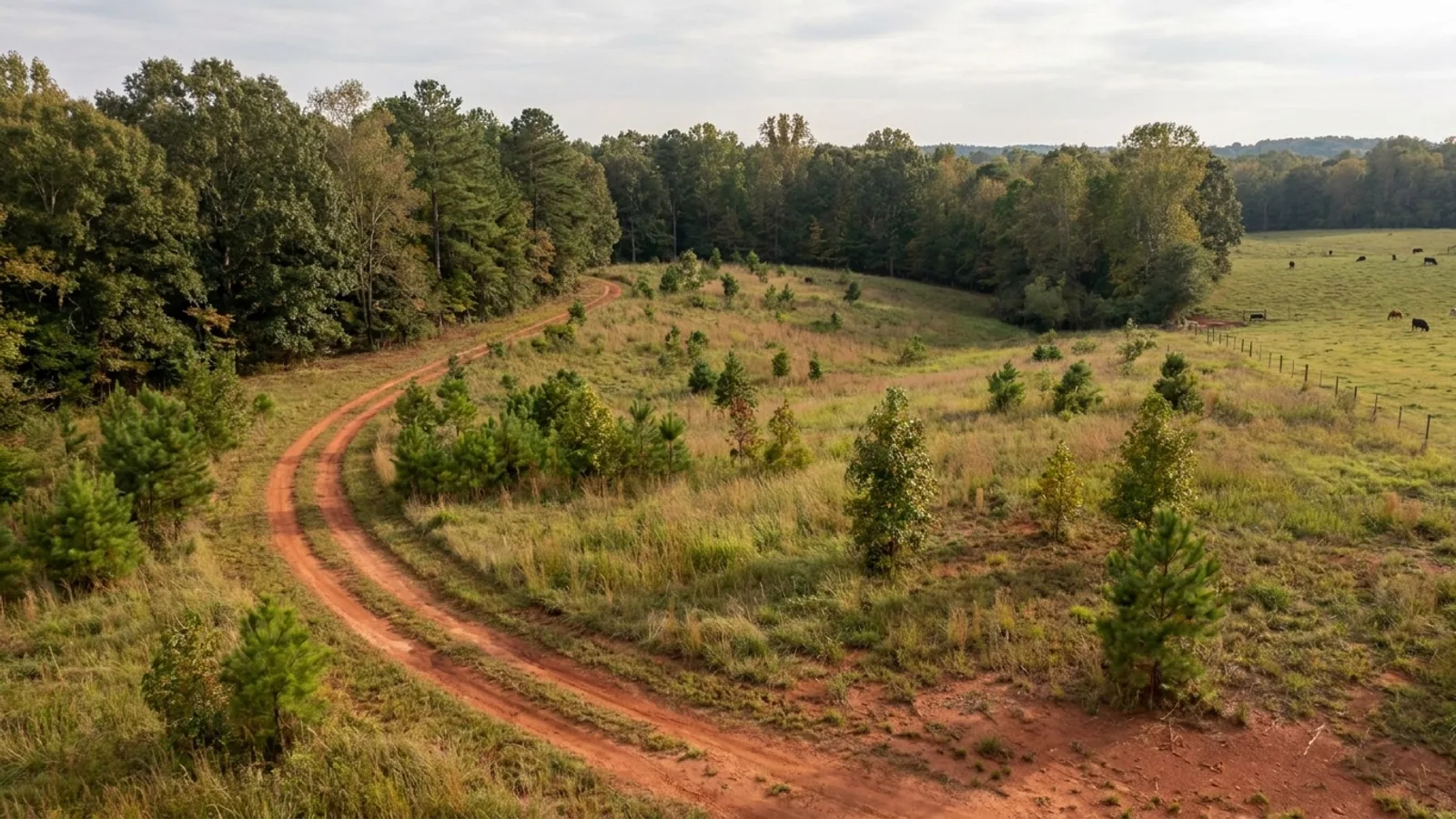
The parcel
Zoning, setbacks, flood zone and utility access get checked before anything is drawn.
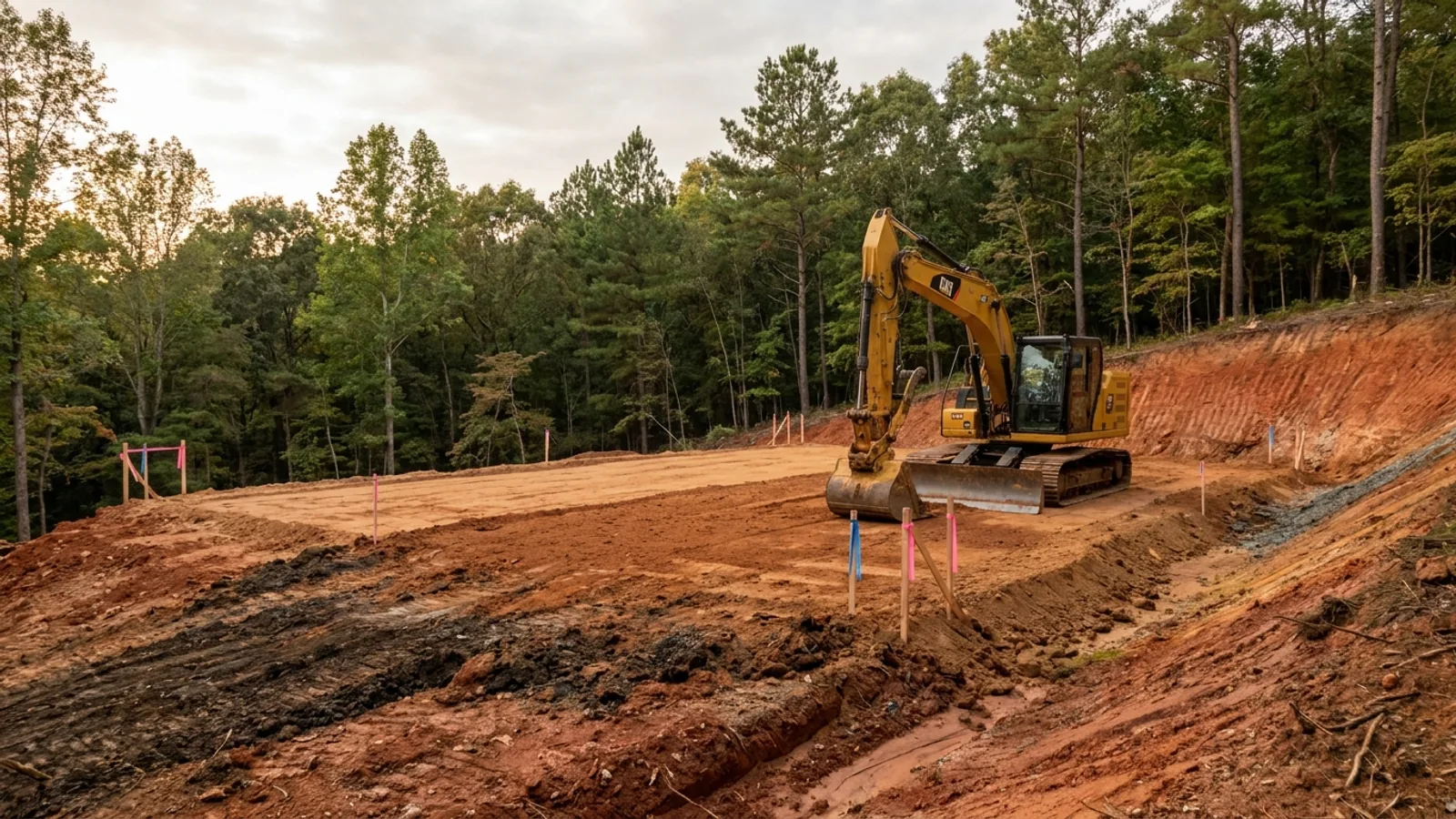
Pad and permit
Clearing, grading and a compacted pad, while the submittal works through Cherokee County.
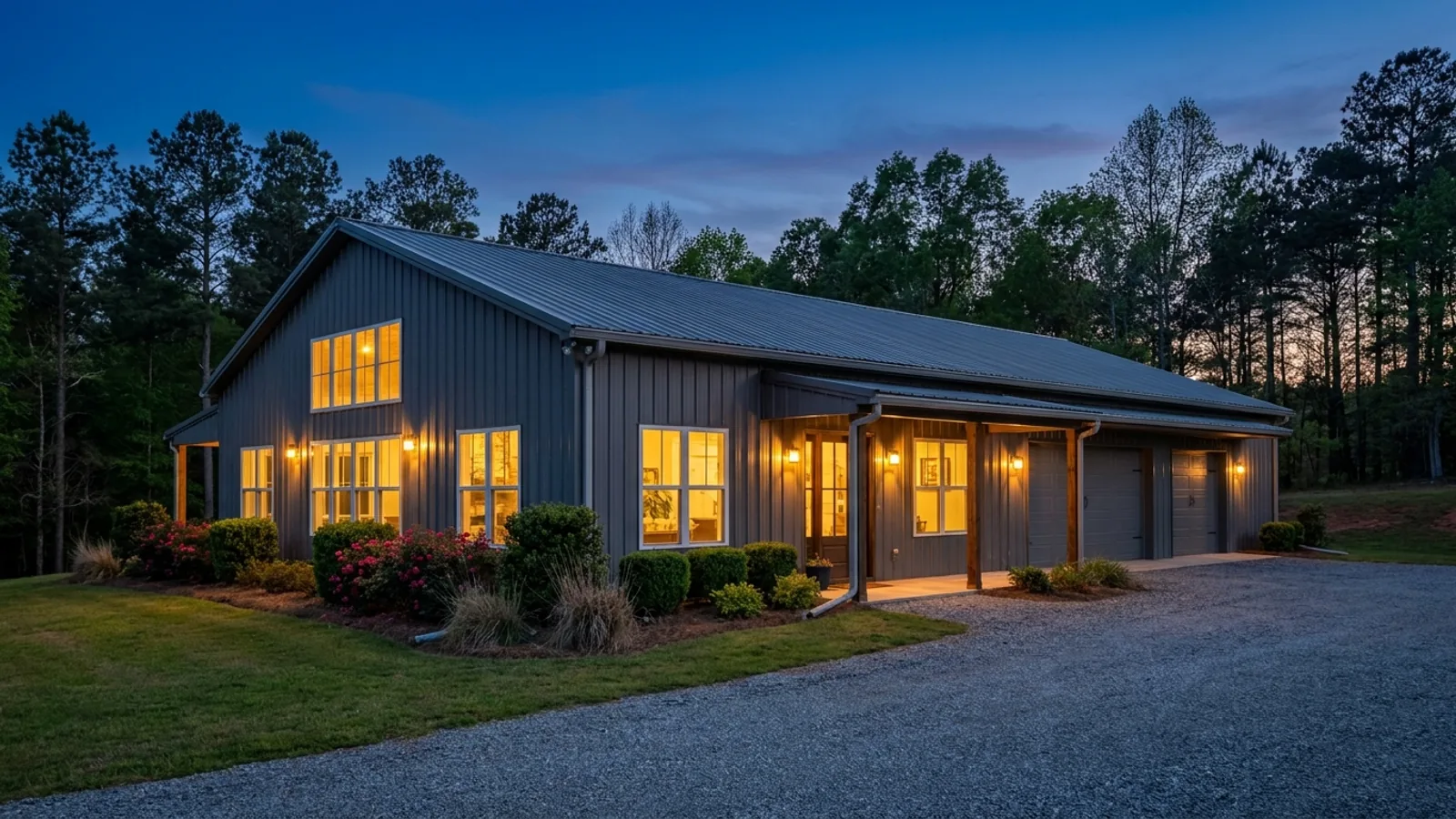
Frame to finish
Shell erected and dried in, then systems, insulation and interior finish through to CO.
Those are the rules for Cherokee County. Tell us what you want to build and we will draw it to them.
Where we build around Cherokee County
Cherokee County and the rural land around it. The buildable acreage for a project this size usually sits outside the city limits, which is frequently what changes who issues your permit.
Keep reading
The questions that usually come next once you know what Cherokee County allows.
Barndominium Cost Guide
Sourced per-square-foot ranges by tier and by size, with a calculator built on the same figures.
Read itIs It Legal in Georgia?
Classification, zoning, the HOA gate, and the agricultural exemption that does not cover a home.
Read itHow Long Does It Take?
Census build-duration data, and the Georgia statute setting the permit clock.
Read itSources for this page
The primary documents behind the Cherokee County figures above. We would rather you checked them than took our word for it.
- Cherokee County Code of OrdinancesZoning districts, minimum lot sizes, setbacks and height limits, as adopted.library.municode.com
- O.C.G.A. § 8-2-25Why the state minimum codes apply even where a county does not enforce them, and the farm-building exemption that expressly excludes residential use.law.onecle.com
- O.C.G.A. § 8-2-26The five-business-day completeness notification, and the deemed-approved provision on the private professional provider route.codes.findlaw.com
- Georgia DCA: Mandatory and Permissive State CodesWhich nine codes apply statewide regardless of local adoption, and which require a local ordinance first.dca.georgia.gov
- ASCE 7 Hazard ToolLook up the design wind speed at a specific address rather than reading it off a contour map.asce7hazardtool.online
Nearby areas we build in
Others we cover in this part of Georgia. The permitting authority, the adopted design criteria and the zoning can all differ from one to the next.
Building in Cherokee County: common questions
6 questions we get asked most often about building in Cherokee County. If yours is not on the list, ask it directly.
Can I build a barndominium in Cherokee County, and what zoning do I need?
Does Cherokee County actually inspect the work, or is it a permit-and-forget county?
The county permits my land, or does the city?
How much land do I really need for the septic system?
Can I put up the shop first and live in it while the house goes up?
Will the county make me put siding on a metal shop?
Building in Cherokee County?
Start with the plan. Tell us what you want to build and we will draw it, then confirm what Cherokee County will actually let you put on the parcel and what wind load it has to meet. That conversation costs nothing.