Barndominium Builders in Augusta, GA
Augusta and Richmond County have been one government since 1996, so the same department that zones your parcel also inspects the building. Augusta's Agricultural zone is not a district drawn on a map, it is the default for every acre never given another zone, and it carries no large-acreage minimum. What usually sets the real minimum lot size here is septic: most of Richmond County sits over the Cretaceous aquifer recharge area, where a house on a drain field needs a lot 110 to 150 percent larger than the state table would otherwise require.
Augusta at a glance
- County
- Richmond County
- Population
- 201,980
- Cities and towns
- Augusta, Hephzibah, Blythe
Building conditions in Augusta
What actually changes from one Georgia jurisdiction to the next: who issues the permit, what wind speed the structure has to be engineered to, and what the ground is like. These are the numbers your drawings have to satisfy.
Augusta Planning & Development Department, augustaga.gov/3176/Planning-Development, fetched 31 Aug 2026
Augusta-Richmond County Code, Title 7, Ch. 1, Secs. 7-1-1 and 7-1-16, Municode, fetched 31 Aug 2026
Corroborated from the South Carolina Building Codes Council wind speed map for Aiken County across the river and Fayette County, Georgia's published criteria table, both fetched 31 Aug 2026
Comprehensive Zoning Ordinance of Augusta, Georgia, Secs. 7-1, 8-7 and 8-9, November 2019 edition, augustaga.gov, fetched 31 Aug 2026
Augusta Groundwater Recharge Area Protection Ordinance, adopted October 1998, described in Augusta-Richmond County Comprehensive Plan Ch. 8, augustaga.gov, fetched 31 Aug 2026
Augusta Planning & Development, Plan Review Information, augustaga.gov/1098/Plan-Review-Information, fetched 31 Aug 2026
Also worth knowing before you build in Augusta
- Savannah River corridor
- Within 100 feet of the river bank a single-family dwelling needs a tract of at least two acres, only one dwelling per tract, and the drain field must sit outside the buffer even though the tank may sit inside it.
- Soils at the Fall Line
- Augusta sits where the Savannah River crosses the Fall Line. About two thirds of Richmond County is well-drained Sand Hills and Coastal Plain soil with a sandy surface over loamy subsoil, not the shrink-swell red clay of North Georgia. Around a fifth is poorly drained floodplain soil.
- Floodplain
- The Savannah River floodplain runs the entire northeastern side of the county and covers about 63 square miles. Work in a flood zone needs a flood permit and an elevation certificate through Zoning before a building permit can be issued.
- Fort Gordon
- The Army post southwest of the city covers roughly 55,600 acres, about 87 square miles, most of it inside Richmond County. It is a large share of the county that is simply not available to build on.
- Land market
- About 1,700 acres of rural land and property listed in Richmond County, worth more than $116 million. Recorded sales run to a median around $7,675 an acre against a median asking price nearer $10,162.
- Zoning rewrite underway
- Augusta's zoning ordinance dates to the 1960s and is being comprehensively rewritten with consultants WSC White Smith Cousino, with extra funding approved in August 2026. Setbacks and district rules quoted today may not survive the rewrite, so we re-check them at design stage.
Comprehensive Zoning Ordinance of Augusta, Georgia, Sec. 25-D-4, November 2019 edition, fetched 31 Aug 2026
Augusta-Richmond County Comprehensive Plan Ch. 8, soil association shares, augustaga.gov, fetched 31 Aug 2026
Augusta-Richmond County Comprehensive Plan Ch. 8 and Augusta Residential Building Permit Requirements, augustaga.gov, fetched 31 Aug 2026
GlobalSecurity.org and Center for Land Use Interpretation installation profiles, fetched 31 Aug 2026
LandWatch, Acres.com and Land.com Richmond County listings, fetched 31 Aug 2026
Augusta Zoning Ordinance Rewrite page, augustaga.gov/3280/Zoning-Ordinance-Update, and WRDW, 4 Aug 2026, fetched 31 Aug 2026
The expensive surprises are in the ground, not the building
Most of Richmond County rates poorly for dwellings in the soil survey, and the reason is water sitting close to the surface rather than weak ground. That makes the pad elevation and the drainage plan the two line items most likely to move your budget. We price the dirt before we price the building.
What we build in Augusta
All nine services are available across Richmond County. The three below are where a project on a Richmond County parcel usually starts — the permit, the drawings, and the build itself. What a build costs depends far more on the parcel than on square footage, so we price against your land rather than publishing a rate card.
Permitting & Engineering
Sealed structural engineering and the permit that depends on it, from submittal through final inspection.
Custom Plans
Barndominium floor plans drawn to your land, your family, and the 2024 Georgia residential code.
Turnkey Builds
Start to finish barndominium construction: we handle permits, slab, shell, and full interior finish.
What a build looks like
Three stages every Augusta project passes through, from a raw parcel to a finished home. Site work first, because that is where the budget is decided.
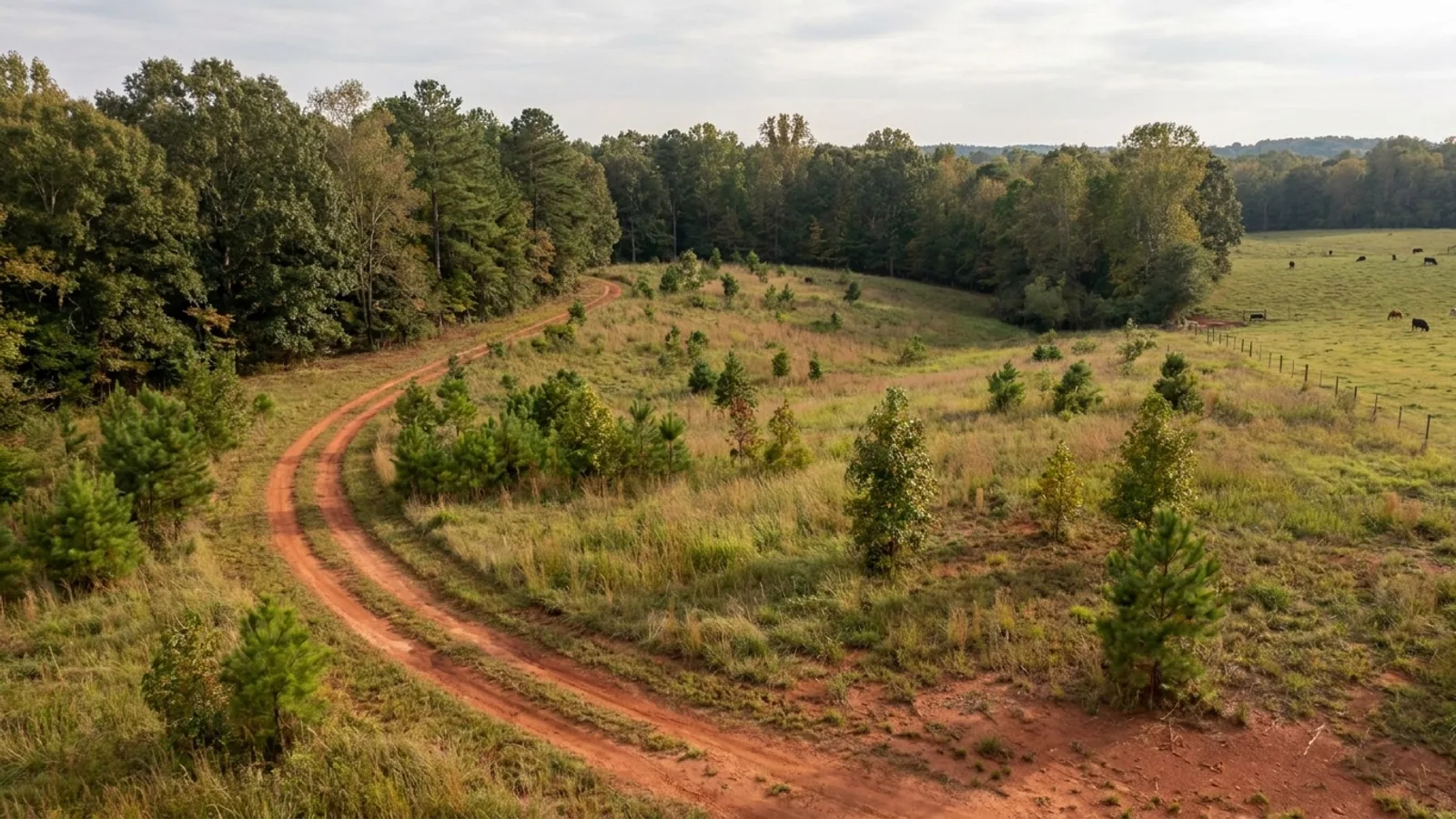
The parcel
Zoning, setbacks, flood zone and utility access get checked before anything is drawn.
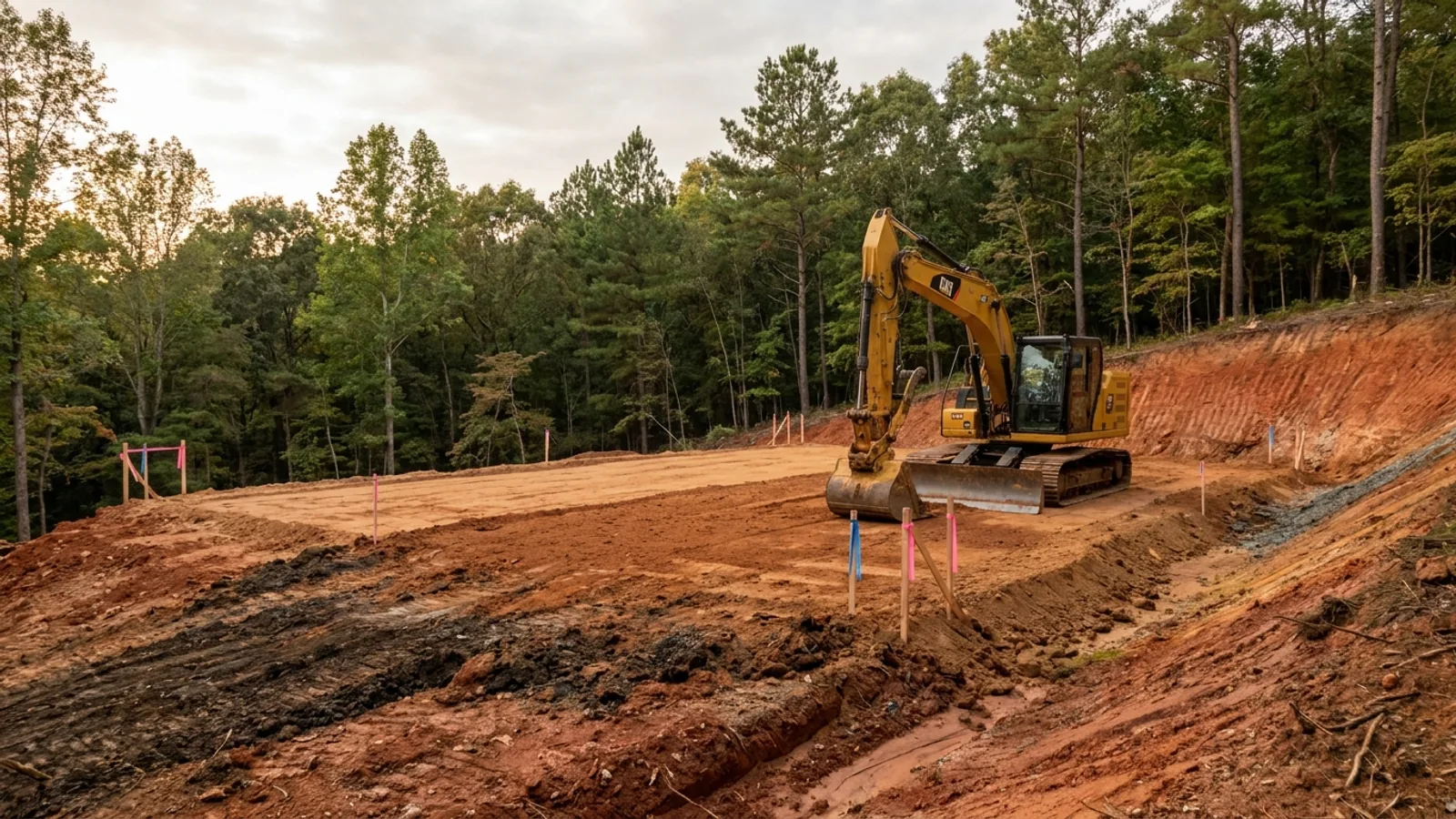
Pad and permit
Clearing, grading and a compacted pad, while the submittal works through Richmond County.
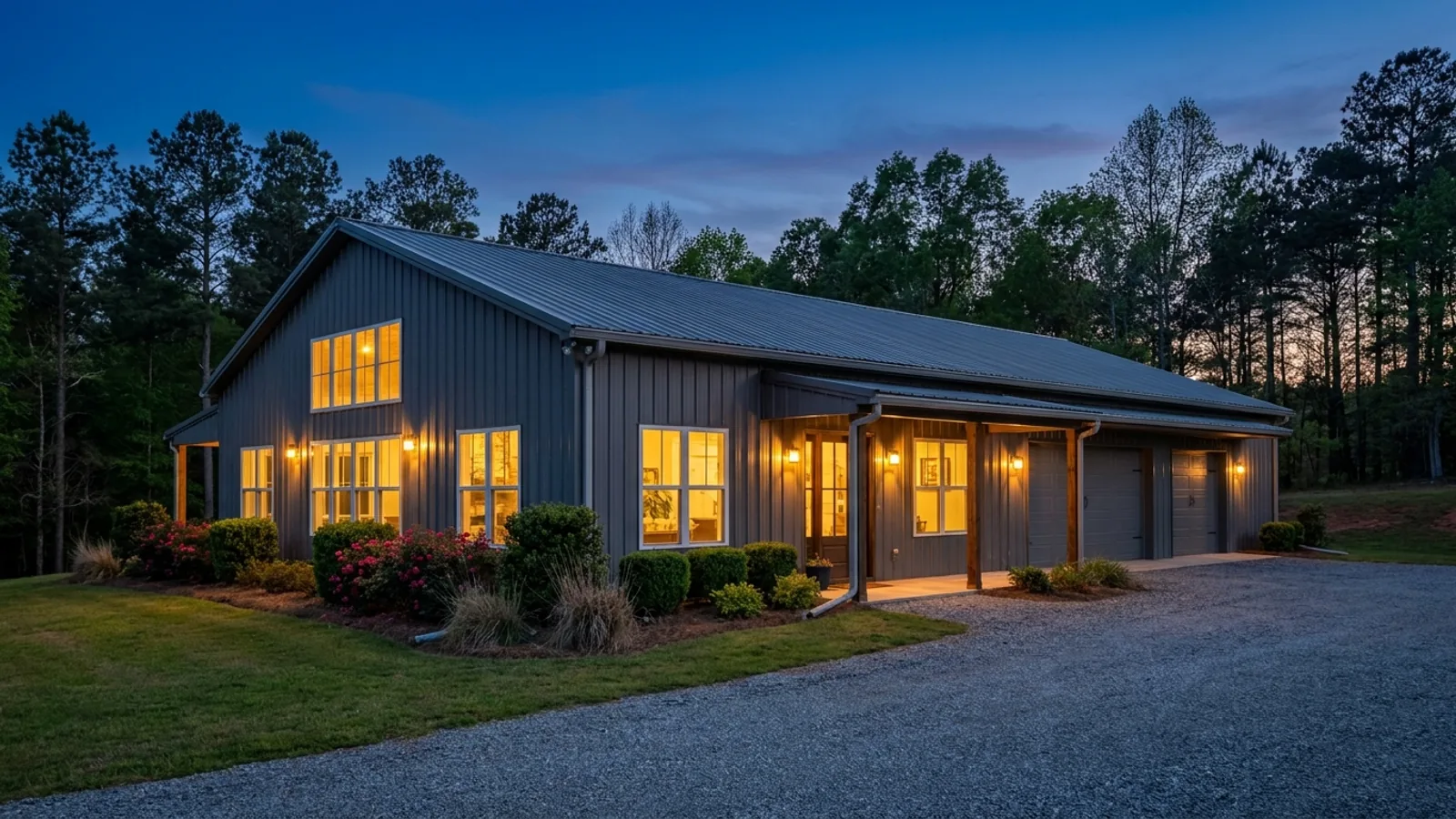
Frame to finish
Shell erected and dried in, then systems, insulation and interior finish through to CO.
Those are the rules for Richmond County. Tell us what you want to build and we will draw it to them.
Where we build around Augusta
Richmond County and the rural land around it. The buildable acreage for a project this size usually sits outside the city limits, which is frequently what changes who issues your permit.
Keep reading
The questions that usually come next once you know what Augusta allows.
Barndominium Cost Guide
Sourced per-square-foot ranges by tier and by size, with a calculator built on the same figures.
Read itIs It Legal in Georgia?
Classification, zoning, the HOA gate, and the agricultural exemption that does not cover a home.
Read itHow Long Does It Take?
Census build-duration data, and the Georgia statute setting the permit clock.
Read itSources for this page
The primary documents behind the Augusta figures above. We would rather you checked them than took our word for it.
- Richmond County Code of OrdinancesZoning districts, minimum lot sizes, setbacks and height limits, as adopted.library.municode.com
- O.C.G.A. § 8-2-25Why the state minimum codes apply even where a county does not enforce them, and the farm-building exemption that expressly excludes residential use.law.onecle.com
- O.C.G.A. § 8-2-26The five-business-day completeness notification, and the deemed-approved provision on the private professional provider route.codes.findlaw.com
- Georgia DCA: Mandatory and Permissive State CodesWhich nine codes apply statewide regardless of local adoption, and which require a local ordinance first.dca.georgia.gov
- ASCE 7 Hazard ToolLook up the design wind speed at a specific address rather than reading it off a contour map.asce7hazardtool.online
Nearby areas we build in
Others we cover in this part of Georgia. The permitting authority, the adopted design criteria and the zoning can all differ from one to the next.
Building in Augusta: common questions
6 questions we get asked most often about building in Augusta. If yours is not on the list, ask it directly.
Does Augusta actually inspect a barndominium, or can I build one uninspected?
My land is zoned A for Agricultural. Does that mean I can't put a house on it?
How big does my lot need to be for septic in Richmond County?
What wind speed will you engineer my frame to?
My parcel backs onto the Savannah River. Does that change anything?
How long does the permit take in Augusta?
Building in Augusta?
Start with the plan. Tell us what you want to build and we will draw it, then confirm what Richmond County will actually let you put on the parcel and what wind load it has to meet. That conversation costs nothing.